 Hey, Nik
≡
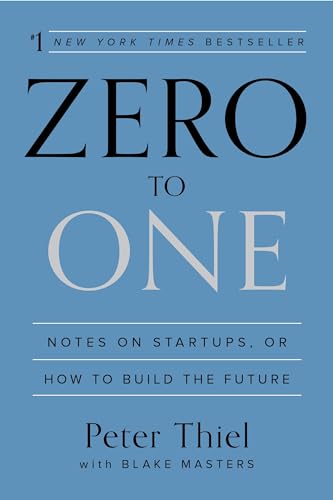
Peter Thiel's central move is a clean one. Doing what already works takes the world from one to n. Doing something genuinely new takes it from zero to one. He spends two hundred pages arguing that the second kind of progress is the only kind worth respecting, and that copying is for people without the nerve to invent.
The framing sticks because it is half right. The half it gets wrong is the half most of us work in.
The interview question alone is worth the afternoon: "What important truth do very few people agree with you on?" It is hard to answer honestly, and harder to keep answering once you notice how rarely you can. The competition reframe is the other keeper. Competing hard in a crowded market grinds your margins to nothing, so the goal is to build something defensible enough that nobody offers a close substitute. Thiel calls that a monopoly and means it as a compliment.
It is also short. You can read it in one sitting and retain most of it, which is not normal for the genre.
Most of the value in a platform team is one-to-n work that Thiel would call copying.
Platform engineering is one-to-n from top to bottom. The job is to take a deployment pipeline that works for one team and make it reproducible for fifty. A shared telemetry library, a golden path, a CPS 230 control replicated across every squad so the auditors see identical evidence everywhere: all of it is copying in Thiel's sense, and all of it is most of the calendar.
Thiel files that under imitation and ranks it the low-risk, low-reward option. For a founder choosing a bet, that ranking is fair. As a verdict on what most engineers do all day, it misleads, because he is half-arguing against his own book. His chapter on distribution says an invention nobody can deliver is a bad business. Distribution is spreading. He respects the spreading of products and disdains the spreading of knowledge, and never spots the seam between the two.
The useful idea sitting underneath the book is a division of labour between discovery and distribution. Someone finds the secret. Everyone else has to make it travel, and making it travel well is its own difficult, badly paid craft. That craft is the whole pitch of a platform team.
The book sits at 4.14 on Goodreads across more than four hundred thousand ratings, a strong score with a loud dissenting tail. Around three in four readers give it four or five stars. The dissenters are worth your time too.
The most common complaint is survivorship bias. The examples are winners picked after the fact, and in a pool of twenty successes you can always find one that fits whatever story you are telling. Several reviewers push on the zero-to-one premise itself, arguing that most progress is incremental and that even PayPal and Palantir were built on layers of prior work rather than conjured from nothing. A recurring observation is that the book opens strong, turns trite in the middle, and ends somewhere stranger, which tracks with its origins as lecture notes rather than a single sustained argument. Plenty also note that Thiel enjoys being contrarian for its own sake, then quietly redefines words like monopoly and competition to win arguments he has already set up.
Read it for the contrarian question and the monopoly reframe. Both will change how you look at a roadmap. Just don't let the title shame you into thinking your actual work is second class. Most of the value in regulated platform engineering gets made on the one-to-n side, quietly, by people making good ideas reproducible under conditions Thiel never had to operate in. He is optimising for the rare moment of invention. You are running everything that has to happen afterwards, and that is the part that keeps the lights on.